

Self-catering holiday accommodation and country cottages in East Anglia, England
East Anglia can be found in that section of England that juts out into the North Sea to the immediate north east of London and encompasses the counties of Essex, Suffolk and Norfolk. All three counties share a coastline, which is industrial in the south near London, more mud than sand further north, with sandy beaches to be found even further north at Clacton on Sea, Frinton on Sea, and Walton on the Naze in Essex, and many more good sandy beaches in Suffolk and Norfolk. Sailing is popular in many of the coastal towns and estuaries - there are yacht clubs galore.
When people contemplate cottage holidays in East Anglia, most think of the seaside resorts on the north Norfolk Coast such as Wells-next-the-Sea or Southwold in Suffolk, or Walton-on-the-Naze. All these seaside towns offer very good seaside holidays in East Anglia but the countryside should not be overlooked. Much of East Anglia is flat and ideal for cycling or gentle rambles. It is also attractive and has much to offer for photographic holidays.
Click for cottages in the East Anglia area
Throughout East Anglia, you will stumble across charming villages with a green and frequently the obligatory duck pond complete with ducks. Often a church or pub overlooks the green which is the central point of the village. Wereham Green in Norfolk is shown on the left.
Each of these counties has a different character. Essex, perhaps because of its proximity to London is the most densely populated and travelling from south to north becomes much more rural with charming villages - some with thatched cottages. Interestingly enough, Essex does not have a single city. Chelmsford, the main town of Essex, despite having a cathedral, lost out in its bid for city status to Preston in 2002.
Colchester is the earliest recorded town in England with much remaining evidence of its Roman occupation. It has a very good shopping centre and an interesting section with narrow lanes and small specialist shops. The castle and zoo are both well worth visiting.
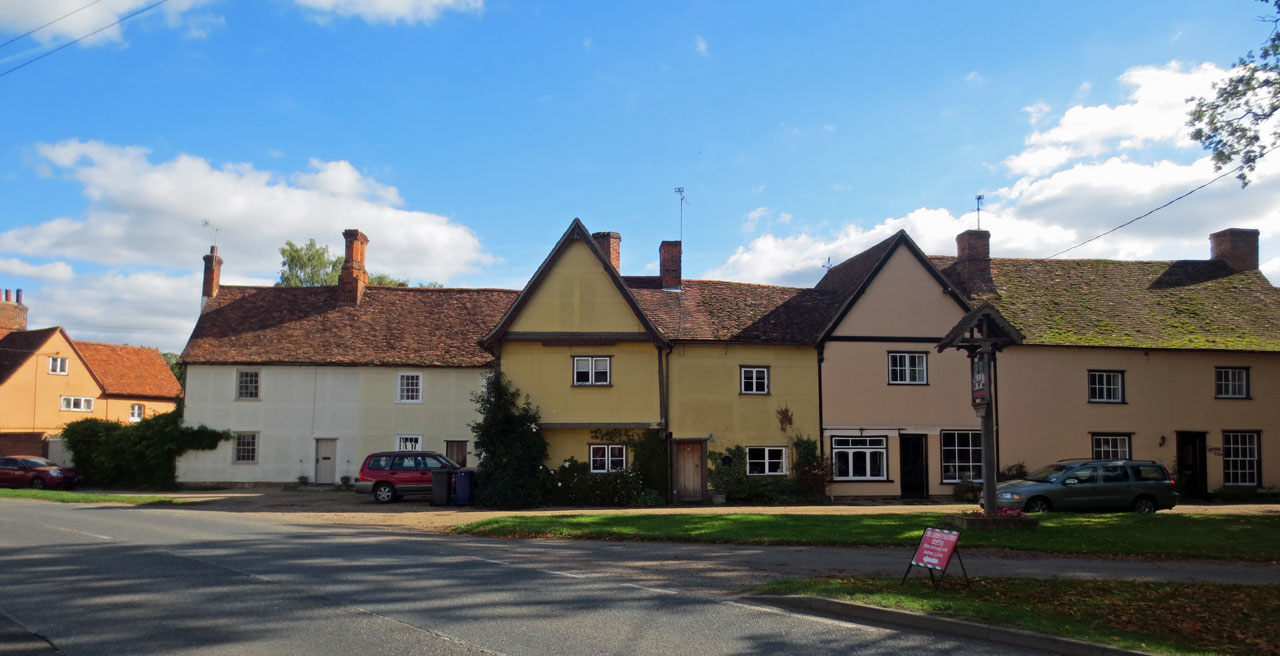
Suffolk is a lovely county with many buildings dating back to earlier centuries. Colour-washed and half-timbered buildings are plentiful. Sometimes it feels as though you have gone back in history to medieval times, especially in villages like Lavenham with a wealth of historic buildings. The villages are pretty, set in inspirational landscapes ( river scene from Stratford St. Mary). This is Constable Country, with a Heritage Coast, historic market towns and charming people. Life runs at a slower pace in Suffolk and Norfolk and it is truly a delight to visit.
Norfolk, is one of the driest county of Britain and certainly one of the flattest. It has a natural, unspoilt coastline with clean sandy beaches, where many people enjoy summer holidays. It is famous for its fens which are drained and reclaimed marshes and bogs and for the 200 km of rivers and shallow lakes known as the 'Norfolk Broads', popular for boating holidays. This is the county where swans, geese, wigeon and pochard overwinter, where particular wetland plants flourish and dragonflies make their home. Windmills, reminders of an industrial past, still stand as landmarks. The cathedral city of Norwich is an interesting place to visit with a castle museum, excellent shopping and leisure facilities, river boats rides and tons of art and culture.
The Norfolk Coast Path runs from Hunstanton in the West to Cromer in the east and takes the visitor through a designated Area of Outstanding Natural Beauty. Wildlife is plentiful. With many laid out paths and trails, it's an ideal location for ramblers. Being rather flat, Norfolk is also excellent for cyclists. Some of the finest nature reserves in the country await your pleasure. Bird watchers will be in their seventh heaven. The bird sanctuary at Titchwell has large reed beds, both sea and freshwater lagoons which are home to many types of wader. Visitors can take a boat trip to visit the seals at Scolt Head.
The Royal Family have a palace in Norfolk, at Sandringham, which was originally purchased by Queen Victoria. Other places of historical interest are the 900 year old castle and cathedral in Norwich, Castle Rising Castle, a Norman Keep dating from 1140, Burnham Thorpe, the birthplace of Nelson, Downham Market (dating back to the Saxons) with its 12th Century Priory.
Families will appreciate a day out to the seaside resorts of Hunstanton, Great Yarmouth, Sheringham and Cromer, which have amusements, cafes and all the fun of the typical British seaside resort. The Bircham and Denver Windmills are open for demonstrations of how flour used to be milled in the old days.
Anyone interested in antiques will find a host of antique shops, centres and fairs throughout East Anglia. There is also a considerable number of boot fairs held on Saturday and Sunday mornings. It's a bargain hunter's delight.
Self-catering Holiday Cottages in Essex, Suffolk and Norfolk
Find a lovely self-catering cottage to stay in whilst exploring Essex, Norfolk and Suffolk using the Feature pages
Associated Essex, Suffolk and Norfolk pages:

- » Self-catering and holiday cottage accommodation White Roding, Essex
- » Self-catering cottages and holiday accommodation Billericay, Essex
- » Self-catering holidays in the south east of England
- » Self-catering rentals in and near Ingoldmells, Lincolnshire
- » Holiday cottages and self-catering accommodation in or near Ludham, Norfolk
- » Self-catering holiday accommodation in Eynsford, Kent
- » Pet-friendly cottages in Wales sleeping at least 4 people and available for Christmas week
- » Self-catering and holiday cottage accommodation Wickford, Essex
- » Self-catering holiday accommodation in or near Culford Park, Suffolk
- » Self-catering and holiday cottage accommodation Romford, Essex

advertise
contact
faq
site map